
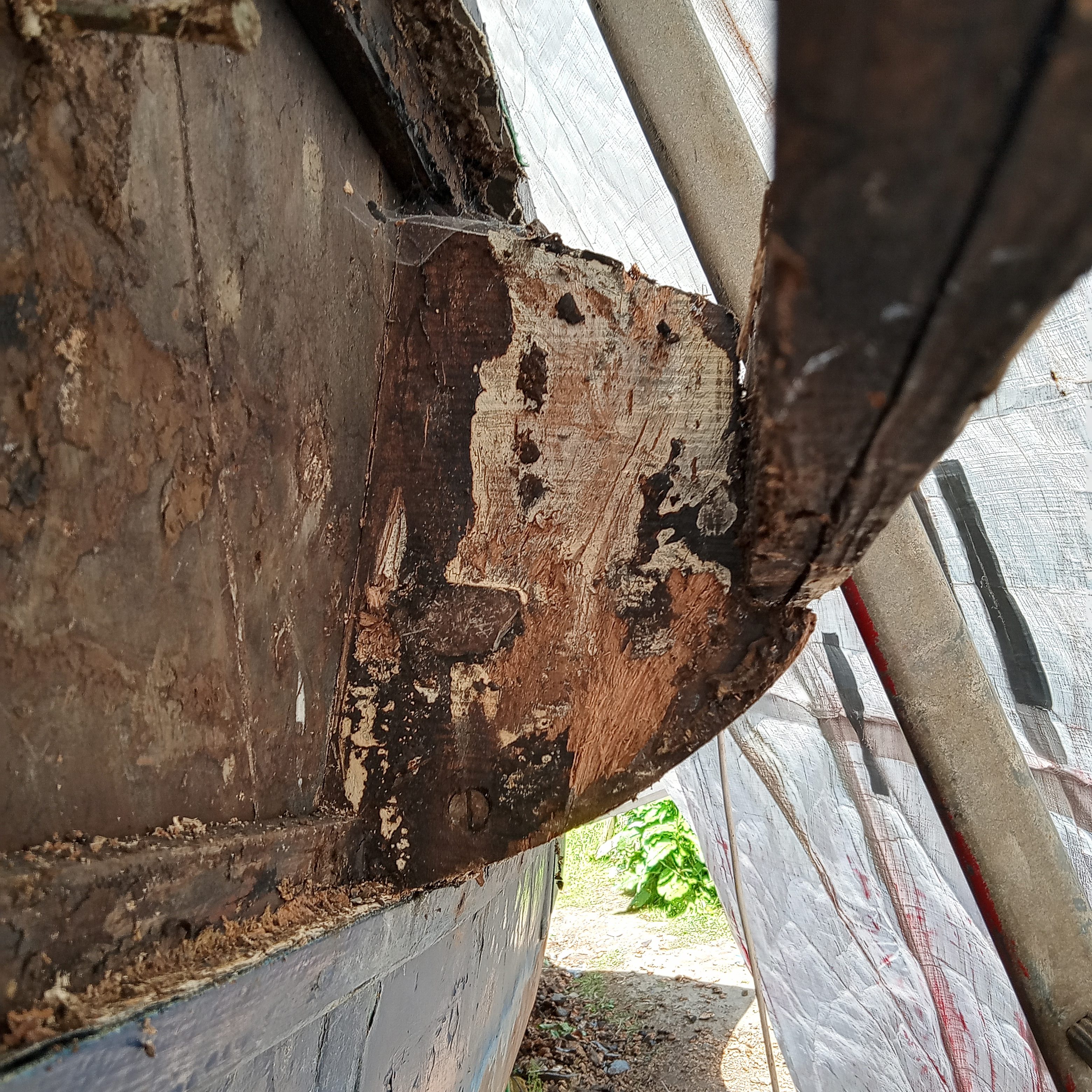
So after removing the wet and decayed cork from Dowager’s massive rubbing strake last week, it’s become clear that her band of hull planking, which had been hidden behind it until now, has suffered extensive rot. In a few areas, such as at the stern, we’ve gotten away with only minor soft patches limited to a few centimetres long.

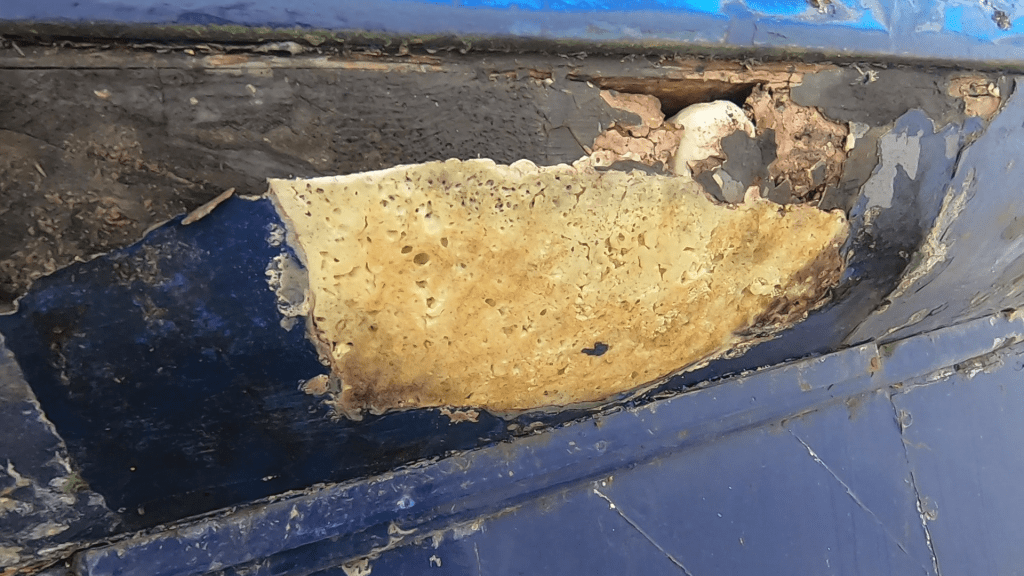
But that small bit of good news flies in the face of the bigger picture, which is pretty horrific. In some places, the planking has decayed full thickness, with a hole leading straight into the starboard fuel bay being just one example.
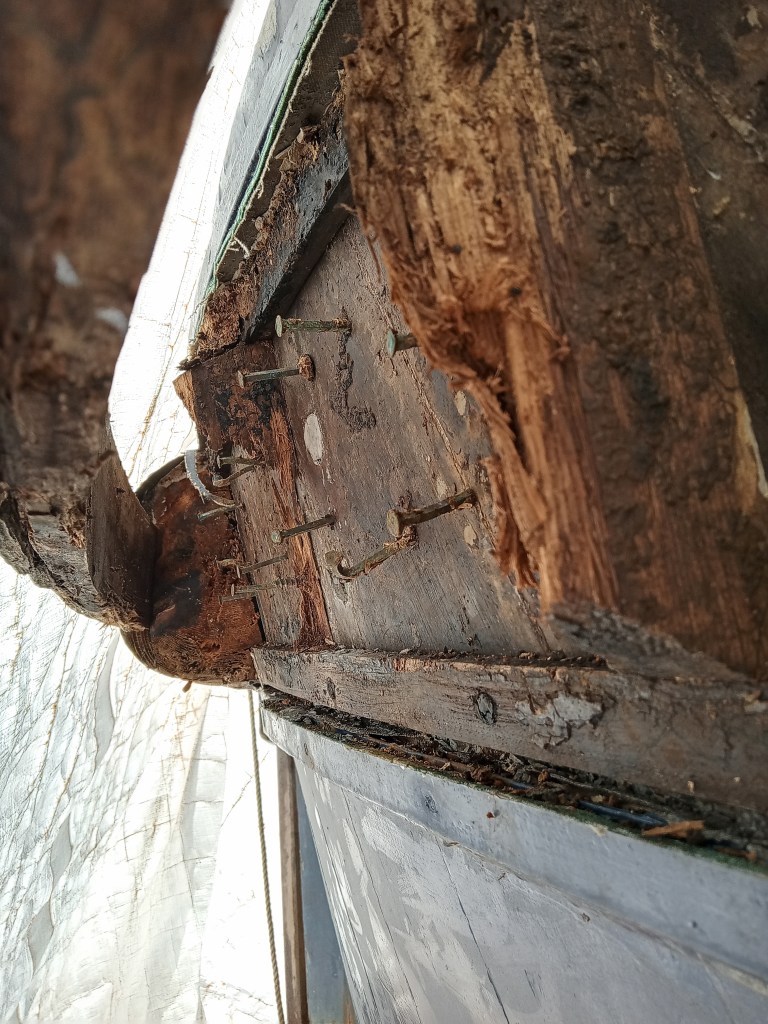
And due to the cork belt being high on the hull, it’s also clear that a lot of the frame along this line has also softened, right where steel knees bracing the deck are riveted.
So that’s not only a double layer of mahogany planks which need replacing, but a good amount of the oak frame and its steel knees which need chopping away and re-fabricating (I stopped counting the number of steel knees required when I reached forty).
And that all needs doing along the entire length of the boat on both sides.
Unfortunately it doesn’t get any better when it comes to the belt’s framework either. The whole lot, save for some of the outer railing, will need to be replaced with fresh timber.
Whilst I was dismantling the existing structure to get down to the hull, a lot of the cork had rotted long ago due to it being saturated with water for such a long time. What also became clear were the rather creative ways that alternative materials had been used to replace this cork at various points in its life.
As I stripped away each layer, I found everything from insulation foam sheets, expanding builder’s foam, and even Portland cement had been applied in various locations along its length. It was no surprise that wherever such work had been done, the hull planking was in a worse condition for it.
For now, I’m removing the last of the belt’s framework to get back to a smooth hull profile. From there, I need to triage the planking and mark-up what can be saved and what needs tearing out.
Any new planks will be scarf-jointed to the existing structure, and for that, I’ll be making a simple routing jig from plywood to get a (near) perfect angle for the joint.
I’ll be sure to provide an update on this in a video to show the whole process of plank replacement since there’s so many steps to follow from start to finish.
Until next time, stay safe out there.

 DOWAGER
Leave a comment